
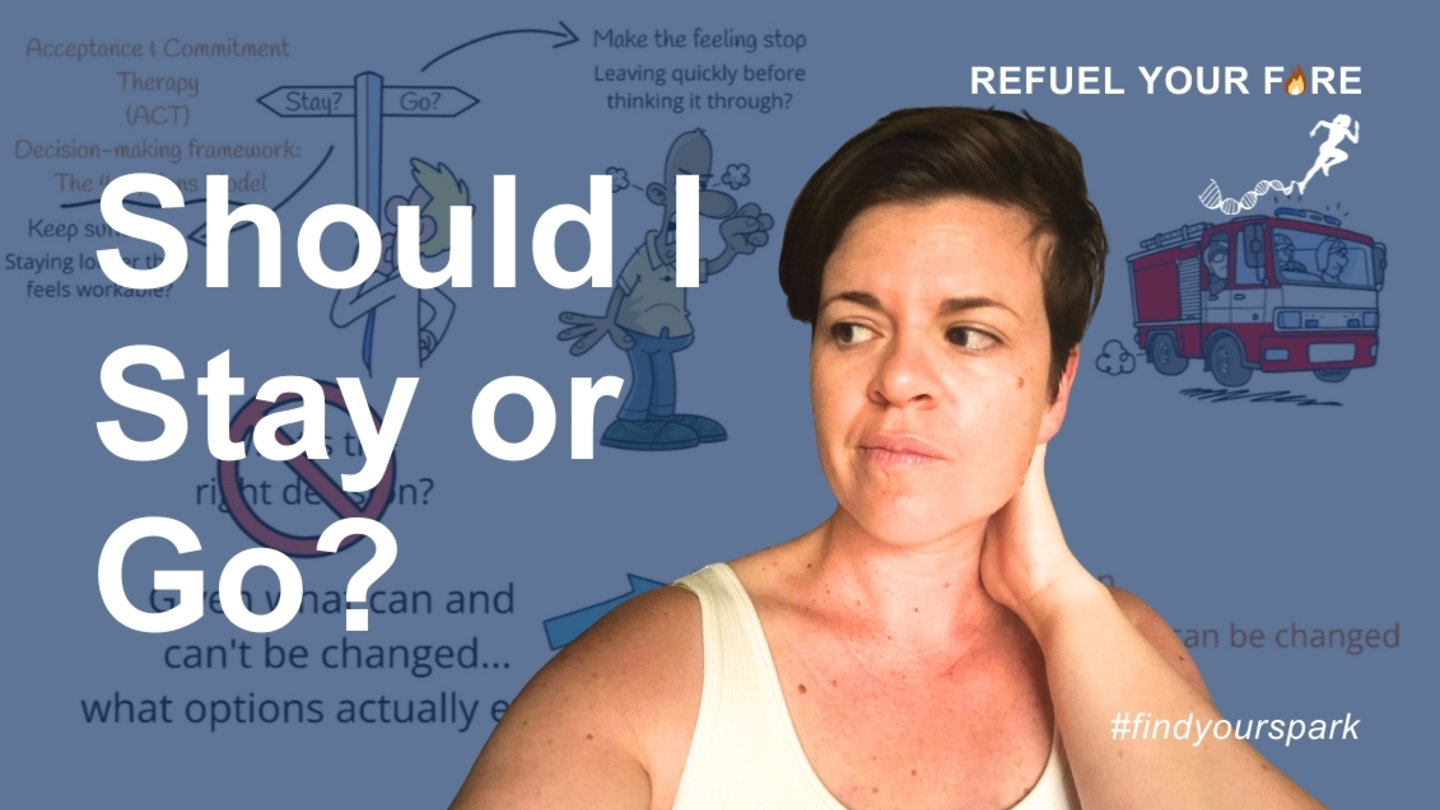
Should I stay or leave?
There’s a point many people reach where the question “Should I stay or leave?” starts looping on repeat.
When emotional overwhelm is high, the brain tends to collapse complex situations into false binaries: stay vs leave, cope vs quit, push through vs burn everything down.
This is where decision-making becomes exhausting rather than clarifying.
The goal of this framework isn’t to tell someone what to do. It’s to slow the moment down enough to restore regulation — so decisions come from clarity rather than panic, shutdown, or emotional flooding.
Instead of asking “What’s the right answer?” A more useful question becomes:
“What does my nervous system need in order to make this decision well?”
The 4 Options Model, a decision making framework from Acceptance and Commitment Therapy (ACT) helps to create space for that clarity by naming choices that often exist between staying and leaving options that are easy to miss when someone is overwhelmed, burnt out, or dysregulated.
The video below outlines this approach in further detail:
To access helpful resources related to prioritising physical and emotional safety, visit 1800RESPECT's website here: https://1800respect.org.au/ To find out more about Lifeline Australia, visit: https://www.lifeline.org.au/ If you're outside of Australia and need support, seek local crisis services in your country. To find out more about my free 12-month roadmapping workshop, visit:: https://refuelyourfire.podia.com/build-your-12-month-roadmap
The 4 Options Model
A way to reduce overwhelm and regain decision clarity:
Option 1. Leave
Exiting the situation entirely. This may be necessary when the environment consistently overwhelms the nervous system or conflicts with core needs, values, or safety.
Option 2. Stay and accept what can’t be changed
Remaining in the situation while consciously acknowledging the limits of what is within control. This option often reduces internal friction when fighting reality is creating more distress than the situation itself.
Option 3. Stay and change what can be changed
Staying while intentionally adjusting variables that are within influence such as boundaries, communication, workload, expectations, routines, or support systems.
Option 4. Stay and rely on unhelpful emotional control strategies
Remaining in the situation while relying on coping patterns that may reduce discomfort short-term but increase stress long-term. Examples might include avoidance, emotional suppression, people-pleasing, overworking, or numbing.
Video Transcript
What if difficulty making a decision isn’t about not knowing what to do…
but about trying to decide while carrying a lot of emotional weight?
Some decisions aren’t small.
They come with history, identity, and consequences.
And often the question underneath isn’t what should I do —
it’s should I stay, or should I go?
Today, we’re looking at a decision-making framework from Acceptance and Commitment Therapy that’s designed for exactly these moments:
the 4 Options Model.
Stay-or-go decisions rarely happen in neutral conditions.
They tend to show up when:
- emotions are high
- the nervous system is under strain
- relief feels urgent
Under emotional load, the mind often narrows the options down to two:
Stay and keep suffering —
or leave and make the feeling stop.
Sometimes that leads to staying far longer than feels workable.
Other times, it can lead to leaving quickly, before the decision has really been thought through.
Neither response is a flaw.
They’re understandable attempts to reduce pressure.
The ACT 4 Options Model doesn’t ask, “What’s the right decision?”
It asks a more grounding question:
“Given what can and can’t be changed here, what options actually exist?”
Those options are:
- Leave the situation
- Stay and change what can be changed
- Stay and accept what can’t be changed
- Stay and rely on emotional control strategies
All four are real.
All four are used by humans every day.
The difference is how sustainable they are over time.
Before unpacking these options, one important clarification.
This model assumes a basic level of physical and emotional safety.
If a situation involves fear, intimidation, coercion, or harm — particularly in relationships — then safety and support come first.
In those cases, decision frameworks aren’t about optimisation.
They’re about protecting wellbeing.
Support resources are linked below.
Option 1: Leave
Leaving can be a values-aligned, self-respecting choice.
It can also be driven by urgency — the need for immediate relief.
Leaving can sometimes happen quickly — especially for those who struggle with impulsive behaviour, or when emotional intensity makes leaving feel urgent.
The question here isn’t “Am I allowed to leave?”
It’s “Am I leaving toward something meaningful, or away from discomfort?”
This pause isn’t about discouraging leaving.
It’s about helping the decision cost less over time.
Option 2: Stay and change what can be changed
This option focuses on influence.
Boundaries.
Communication.
Structural changes.
Small experiments.
It asks:
What is actually within reach here?
This option preserves agency — even when circumstances aren’t ideal.
Option 3: Stay and accept what can’t be changed
Acceptance doesn’t mean approval or giving up.
It means acknowledging reality as it is —
and choosing how to respond without constant internal resistance.
Options 2 and 3 can be used together.
Most situations require both: changing what you can and accepting what you cannot.
Acceptance often frees up the energy needed to make change sustainable.
Option 4: Stay and rely on emotional control strategies
This looks like suppressing feelings, avoiding issues, numbing out, or over-rationalising.
It can work in the short term.
But over time, it often leads to exhaustion, resentment, or burnout.
And it’s important to clarify here
This is not the same as emotional regulation.
Emotional regulation is a skill —
it’s about understanding, working with, and supporting your nervous system.
Emotional control is about forcing yourself to function despite what’s happening inside.
Option 4 isn’t a failure —
it just tends to be less sustainable if it’s the only strategy used.
When emotions are intense, the mind tends to collapse these four options into two.
This model re-expands the picture.
It slows impulsive exits without trapping people in situations that aren’t sustainable.
It creates space between feeling and action —
which is where values-based decisions live.
And one last thing.
If a decision feels too heavy to hold alone, support can help.
In Australia, Lifeline is a free, confidential service where you can talk things through with someone trained to listen.
You don’t have to be in crisis.
You don’t need to know the answer.
Sometimes sharing the weight of the question is enough to create clarity.
Details are in the description.
Decision difficulty isn’t a personal failure.
It’s often a sign of load.
Frameworks like this don’t remove hard choices —
but they can make those choices kinder, clearer, and more aligned.
If this video helped put language to something you’re navigating,
liking it helps this content reach others who are carrying similar questions.
Subscribing means more tools like this land in your feed.
And if planning the year ahead feels overwhelming especially after periods of burnout or high emotional load — I’ve created a free online workshop on planning in a way that works with capacity, values, and real life.
You’ll find the link in the description.
Take what’s useful.
Leave the rest.
In the spirit of reconciliation I would like to acknowledge the Gadigal People of the Eora Nation where I live, work and play. I pay my respects to their Elders past and present and extend that respect to all Aboriginal and Torres Strait Islander peoples living and working on the land today - the land that always was and always will be, Aboriginal land.
© Copyright 2025 Lauren Kress | Privacy Policy | LinkedIn | Youtube | TikTok